


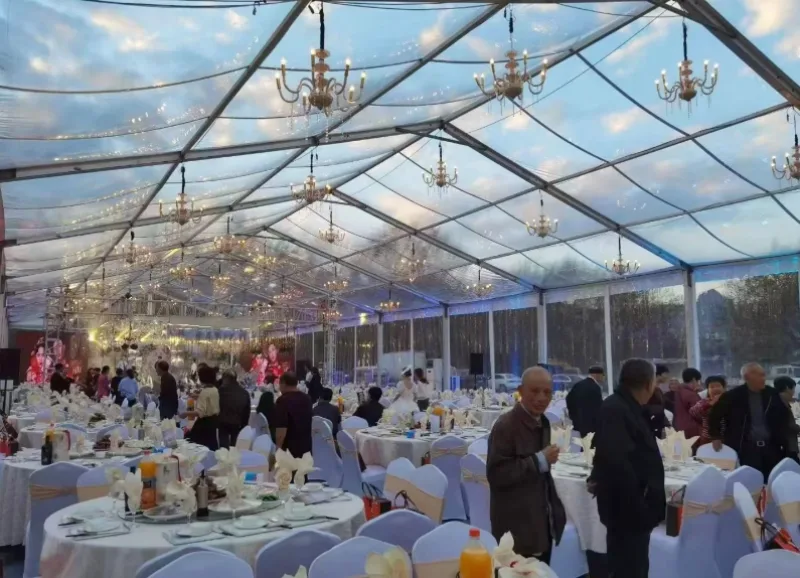
Yes, glass tent weddings do have certain venue requirements. To ensure the safety of the wedding and the comfort of the guests, there are requirements regarding the ground conditions, venue size, space height, and surrounding environment.
Next, Gaxtent will provide a detailed analysis from multiple perspectives, including the characteristics of the glass tent, venue requirements, environmental factors, and suitability for different types of venues, to help you determine whether your venue is suitable for an outdoor glass tent wedding.
Basic Characteristics of Glass Tents and Their Impact on Venues
Before choosing a venue, you first need to understand the structural characteristics of the glass tent. Understanding these will help you understand why there are venue requirements.
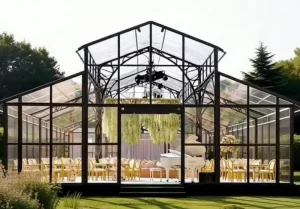
Glass tents or transparent tents are made of transparent or translucent materials, and their frames are supported by aluminum alloy or steel structures. Their biggest advantage is good lighting and an open view. However, this means that there are certain requirements for the flatness and load-bearing capacity of the ground.
If the ground is uneven, muddy, or has serious water accumulation, it will affect the stability of the tent, thus posing certain safety hazards.
In addition, the aesthetics and wedding atmosphere of a transparent tent highly depend on the venue environment. There should be no obstructions around the tent; otherwise, its transparent characteristics cannot be fully utilized, and the desired effect cannot be achieved. This may affect the comfort of the wedding and the quality of the photos.
Core Venue Requirements for Glass Tent Weddings
Glass tent weddings have multifaceted venue requirements, including requirements for the ground conditions, venue size, space height, and surrounding environment.
Ground Conditions
When choosing a venue, the first thing you need to consider is the ground conditions, which is fundamental.
First, you need to ensure that the ground is flat, avoiding slopes or potholes; otherwise, the tent will be unstable after installation, posing safety hazards.
Secondly, the load-bearing capacity must meet the requirements, especially on lawns, soil, or sand. It is best to reinforce the foundation to support the weight of the tent frame and internal furniture.
Finally, drainage should not be overlooked. Water accumulation during rainy days not only affects comfort but may also pose safety hazards. Therefore, it is recommended to plan a drainage system in advance or improve the ground conditions by raising the ground level.
Venue Size
The venue size directly determines the number of guests and the feasibility of the internal layout. Taking a wedding with 50-80 guests as an example, approximately 100-200 square meters of basic space are usually required. Ensure the glass tent has sufficient space for installation and operation.
Additionally, extra space needs to be reserved for the stage, dining area, dance floor, and walkways to ensure smooth operation and meet safety requirements.
Space Height and Surrounding Environment
To ensure comfort, a clear height of 3-4 meters or more is recommended for the tent. Furthermore, the surrounding environment will affect installation and the wedding experience; avoid low-lying buildings, large trees, or other obstacles that may interfere.
Wind direction and sunlight also need to be considered; a reasonable layout can optimize guest experience and photography lighting, making the wedding effect even more perfect.
Impact of Terrain and Environment on Glass Tent Wedding Experience
Terrain is very important for glass tents; different terrains and environments directly affect the difficulty of tent construction and the wedding experience.
For example, sloping or irregular terrain usually requires additional support structures and foundation reinforcement, which increases construction costs and requires professional teams for measurement and installation.
In high-wind or rainy areas, wind-resistant anchoring systems and drainage designs are necessary to ensure safety.
Además, transparent tents have high requirements for aesthetics and photography effects; a site with unobstructed views and ample light can maximize the romantic atmosphere of the wedding.
By comprehensively evaluating these factors, you can more clearly determine whether the venue is suitable for a glass tent wedding, avoiding the embarrassment of last-minute construction or unsatisfactory results.
Requirements for Different Types of Venues for Glass Tent Weddings
When choosing a wedding venue, you will find that different types of terrain and environments present both opportunities and challenges.
Lawns or gardens are often the first choice for couples because of their beautiful natural scenery and ample light; greenery and sunlight can make wedding photos more vivid and atmospheric. However, you also need to be aware that lawns may have uneven ground or soft soil. Without prior foundation reinforcement, the tent may shake or become unstable after construction, especially if you plan to set up tables, chairs, a stage, or other decorations. To avoid this, you can prepare anti-slip mats or ground anchors to ensure the tent is stable and safe.
If you are considering a wedding on a beach or by a lake, such venues can create a unique and romantic atmosphere. The sea breeze, the sound of the waves, and the expansive views are natural decorations in themselves, but in reality, strong winds, soft and uneven ground, coupled with tides and weather changes, can all increase construction difficulties. To ensure the stability of your tent, you may need to install an additional wind-resistant anchoring system and compact the ground or lay load-bearing plates before construction.
If you choose a hotel or manor courtyard, the complete facilities, readily available utilities, and high security will save you a lot of trouble during the preparation process. However, you will also encounter the problem of limited space, requiring precise planning of the stage, dining area, and aisle layout; otherwise, guests may feel crowded, affecting the overall experience.
For those seeking unique features, mountainous areas or open-air platforms offer expansive views and a unique experience. However, in reality, inconvenient transportation, uneven ground, and difficulties in foundation reinforcement mean that construction costs and time may be more than double that of flat ground venues. Safety risks also need to be assessed in advance with a professional team.
In general, different types of venues have their own suitable solutions. You need to flexibly adjust the tent design based on your number of guests, wedding layout, and actual needs to ensure smooth construction and a comfortable experience for your guests.

Practical Methods for Determining if a Venue is Suitable for a Glass Tent
During the preparation phase, it’s best to assess in advance whether the venue is suitable for a Glass Tent wedding. This will not only help you avoid potential problems but also save unnecessary expenses.
First, site measurement is essential. You need to confirm whether the venue area is sufficient, the slope is moderate, and the load-bearing capacity can support the tent and furniture. This will prevent shaking or deformation after construction.
Secondly, risk assessment is equally important. For example, if your venue is located in a low-lying area, it may be prone to flooding during rainy days, which could affect the smooth running of the wedding; if the wind is strong, you need to consider additional wind-resistant anchoring measures to ensure the safety of the tent in adverse weather conditions. Even seemingly ideal lawns or lakeside locations may have soft ground or hidden pits, requiring prior reinforcement and drainage design.
Environmental aesthetics are also a factor you cannot ignore. Transparent tent venues are highly dependent on the surrounding landscape. If the view is obstructed by buildings or trees, the photographic results and visual experience will be compromised; insufficient light or unfavorable sunlight angles will also affect wedding photos and the guests’ experience.
Finally, professional consultation is crucial. You can communicate with tent suppliers or wedding planning teams, who can provide construction advice, layout plans, and safety assessments for the venue, helping you solve potential problems in advance. Through this systematic preparation, you can select the most suitable venue during the planning stage, avoiding later adjustments and additional construction, and ensuring your wedding proceeds smoothly and perfectly.
FAQs about glass tent weddings
Are glass tent weddings suitable for all weather conditions?
Glass tents are windproof and rainproof, but extreme weather such as strong winds, heavy rain, or heavy snow may still affect safety. It is recommended to choose a professional construction team and equip a reinforcement system, while also paying attention to weather forecasts and, if necessary, providing temporary shading or rain protection facilities.
How many guests can a glass tent wedding accommodate?
Guest capacity depends on the tent size and layout. A common medium-sized glass tent with a diameter of 6–8 meters can accommodate approximately 25–80 guests. The specific number needs to consider the arrangement of tables and chairs, the stage, and aisle space. Capacity emphasizes a comfortable experience rather than maximizing the number of people.
Do glass tent weddings require special ground foundations or flooring?
Yes, soft ground such as lawns, sand, or soil usually requires reinforced foundations, such as load-bearing plates, ground anchors, or temporary wooden flooring, to ensure the tent is stable and safe, and to facilitate the arrangement of tables, chairs, and the stage. Concrete ground generally does not require additional reinforcement, but still requires anti-slip treatment.
How much does a glass tent wedding cost?
En glass tent wedding cost is affected by the tent size, foundation treatment, interior layout, and rental duration. A medium-sized wedding tent for 50–80 people usually costs between USD $8,000–20,000, and high-end layouts or special venues may cost more. Additional costs include lighting, furniture, decorations, and transportation and installation.
Which venues are best suited for glass tent weddings?
Lawns or gardens are the most common locations, offering beautiful scenery and suitability for photography; hotel or estate courtyards provide complete facilities and high security; beaches, lakeside areas, or mountain platforms offer unique landscapes, but require complex construction and reinforcement. When choosing a venue, consider the area, load-bearing capacity, drainage, wind protection, and photography angles.
Conclusión
Outdoor glass tent weddings do have specific venue requirements, but these requirements are not insurmountable. By choosing a suitable venue and planning the foundation, weather protection, and spatial layout in advance, you can ensure a safe and romantic transparent tent wedding.
The choice of venue directly impacts the safety, visual effect, and guest experience of the wedding, not just whether the tent can be successfully erected. For inexperienced couples, consulting a professional supplier or wedding planner in advance can often save you time and ensure a smooth wedding.



 English
 Spanish
 Arabic


